
The conversation nobody wants to start
You've spent months, maybe years, learning exactly how your body works. Solo time became your language. You know your rhythm, your timing, what builds you up and what brings you over the line. Then a relationship happens. And suddenly, that private fluency gets weird.
Introducing a lemon vibrator to partnered sex after years of single pleasure isn't awkward because vibrators are shameful. It's awkward because you're translating something deeply personal into a shared space. That translation takes intention.
Why solo skills don't automatically transfer
When you're alone, there's no performance. No timing negotiation. No one's rhythm but yours. You're in control of speed, pressure, angle, when to pause, when to push. That autonomy is everything.
Partners, even kind ones, change the math. Their pleasure matters. Their timing matters. Their feelings about toys matter. And the thing that made you feel powerful alone can suddenly feel vulnerable or selfish or complicated when someone else is in the room.
Here's what I see in my practice constantly: people who had orgasms regularly alone suddenly can't finish with a partner, not because their body changed, but because the mental load exploded. You're managing their experience, your arousal, the social story you're telling yourself about what this moment means. That's not a dysfunction. That's just the difference between solo and coupled.
The pre-conversation conversation
Before you bring a lemon vibrator anywhere near the bedroom with a partner, check yourself. Not in a shame way. In a clarity way.
Ask yourself: Am I introducing this because I genuinely want it? Or am I introducing it because I feel like I should hide the fact that I use one solo? One comes from desire. The other comes from fear. They feel different in your body.
If you're genuinely excited, that energy is magnetic. If you're nervous and sheepish, your partner will feel that too. The vibrator becomes evidence of something you're ashamed of instead of a tool for mutual pleasure.
So check in first. "I want better sensation together, and I've found that a clitoral vibrator really helps me get there." Full stop. That's a statement. That's clarity.
How to actually bring it up
The worst way to introduce a lemon vibrator to a partner is to present it as a solution to a problem. "We need this because..." immediately signals deficit. Instead, frame it as expansion.
Pick a moment outside the bedroom. Not before sex, not during sex. A regular Tuesday evening conversation. "I've been thinking about something I want to try together. I know what kind of stimulation my body needs, and I'd like to explore that with you instead of keeping it separate."
Then pause. Let them respond. Don't keep talking to fill silence. The pause is where real reaction lives.
If they seem hesitant, ask why. Really ask. Not defensively. The most common hesitations I hear are: "Will you still want me?" or "Am I not enough?" Those aren't about the vibrator. Those are about security. Address that directly. "Using a vibrator doesn't change how I feel about you. It changes how my body works. Those are different things."
If they're enthusiastic, great. But don't let the conversation end with a thumbs up. Ask what they want from the experience. Are they curious? Turned on by watching? Interested in learning your preferences? Those are wildly different energies.
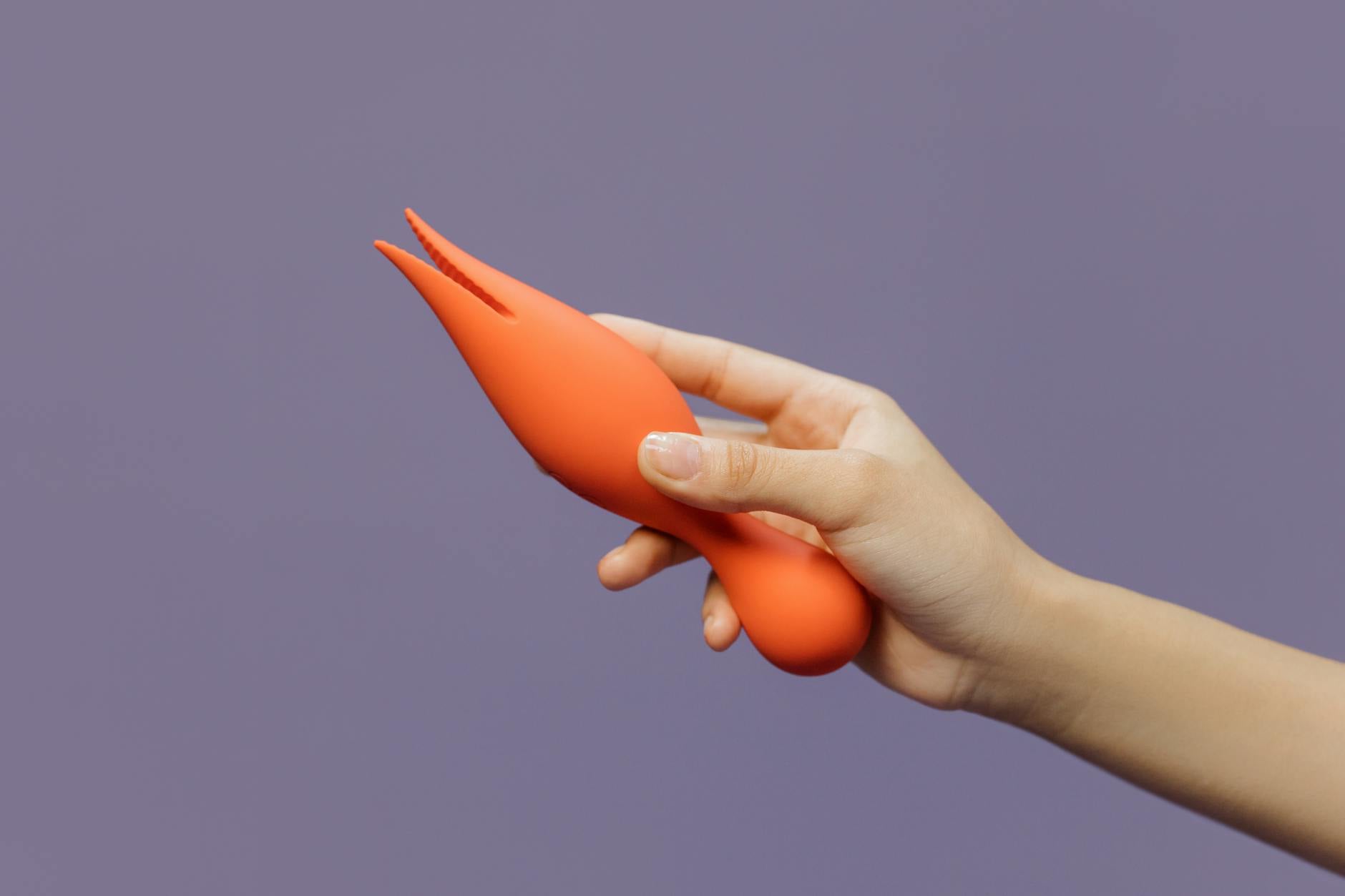
Photo by cottonbro studio on Pexels
The first time you actually use it together
Don't make it a production. That's the biggest mistake. You show up with the fancy vibrator, you've both mentally prepared for This Important Sexual Moment, and now there's performance pressure on top of transition anxiety. Pass.
Instead, use it in a lower-stakes situation. During foreplay, when you're already close, already comfortable. Not as the main event. Not as the thing you're both waiting for. As part of the texture.
Start with it off. Let your partner hold it, see how it feels in their hand, understand the weight and shape. There's something about that de-mystification that helps. It's not magic. It's a tool. It's less intimidating when they can feel it before it's on.
When you turn it on, start at the lowest setting. This is partly about sensation and partly about demonstrating that you know what you're doing. You're not chaotic. You're intentional. You understand your own pleasure well enough to manage it thoughtfully. That confidence is sexy.
If your partner wants to hold the lemon vibrator while you guide, great. If you want to hold it yourself, that's also fine. There's no correct positioning. The correct positioning is whatever lets you relax, because you can't orgasm while you're managing your partner's comfort. That's a fact.
What to do if it feels weird
It will, at first. Your brain is processing: solo pleasure context shifting to partnered pleasure context. That's disorienting. Not bad. Just disorienting.
The weirdness usually shows up as numbness or difficulty climaxing. Your nervous system is on high alert. You're scanning your partner's face, wondering what they think, wondering if you look weird, wondering if this is working. That's not your vibrator failing. That's your brain's threat-detection system running.
If this happens, pause. Not forever. Just five minutes. Talk to your partner about something completely unrelated. Do something that brings you back into your body. Sometimes just saying out loud, "I'm in my head," helps you get out of it.
Or try a different position. Sometimes a position shift flips the mental narrative from "I'm performing" to "We're exploring." Same tool, different frame.
The long-term rhythm
Once you've introduced a lemon clitoral vibrator to coupled sex, decide together how you want to use it. Some couples use it every time. Some use it as a weekend tool. Some rotate between you using it solo and using it together.
All of these are fine as long as they're agreed on. What breeds resentment is ambiguity. "I don't know if my partner secretly wishes I didn't need this" is a slow poison. So be explicit. "Let's use it together on Friday nights, and I'll keep my solo practice on Tuesday." That clarity is loving.
Also: your partner might eventually want their own vibrator. That's not a threat to you. That's parallel development. You don't have to share toys if you don't want to. You can have preferences about that. Honor them.
When communication still feels hard
If you're weeks into introducing a lemon vibrator and it still feels tense or shameful, that might be pointing to a bigger conversation about sexuality and permission in your relationship. That's worth naming. It's not the vibrator's job to fix that.
Some couples find that explicitly talking through pleasure, desire, and needs with a therapist or relationship coach makes the whole transition smoother. There's no shame in that. It's actually one of the most common reasons people come to me. "We want to be closer, but we don't know how to talk about sex." That's a learnable skill.
People also ask
How do I know if my partner is actually okay with me using a vibrator, or if they're just saying yes?
You listen to what happens after the conversation. If they actively engage with the experience, ask questions, show interest in your pleasure, they're likely genuinely on board. If they seem withdrawn, make jokes, or avoid the topic after agreeing, something's underneath. Address it: "I want to check in. Does this feel okay to you?" Real comfort doesn't hide.
Should I use the lemon vibrator by myself less often now that I have a partner?
Absolutely not. Your solo practice is where you maintain your fluency with your own body. That knowledge makes partnered sex better, not worse. Solo time and partnered time aren't competing. They're complementary. One teaches you what you need. The other teaches you how to communicate it.
What if my partner wants to use the lemon vibrator on me but I find it weird?
That's legitimate. You don't have to hand over control of your pleasure to make someone else comfortable. You can say: "I love that you want to, and I'd prefer to guide it myself for now." That boundary is not rejecting them. It's creating the conditions where you can actually relax enough to feel something.
Is using a lemon vibrator together a sign that our sex life needs fixing?
Nope. It's a sign that you're both willing to expand. Some of the couples with the healthiest sexual lives I know use vibrators together. Some use them solo. The common thread is that they talk about pleasure openly and neither person is hiding. That's what matters.
How often should we actually be using it together?
As often as you both want to. There's no rule. If you're discovering that using it together helps you orgasm, you might want it most times. If it's a sometimes-thing that adds variety, that works too. The only frequency that's wrong is the one where one of you is resenting it. Check in regularly: "Is this still feeling good for you?"
What if I can't orgasm with my partner in the room, even with the vibrator?
That's more common than you think, especially after years of solo pleasure. Your brain has built a very specific pathway to orgasm when you're alone. Adding another person requires you to rewire that slightly. It's not impossible. It usually takes time, patience, and a partner who's willing to just be present without adding pressure. Some people find that talking during it helps (dirty talk, affirmations). Some find that music or a different environment helps. Experiment. And if it continues to be difficult, that might be worth exploring with a therapist.
What comes next
Introducing a lemon vibrator to a long-term partnership is less about the toy and more about permission. Permission to know what you need. Permission to ask for it. Permission to not pretend your body works the way it doesn't.
That permission, once it's there, usually spills over into other conversations. About timing. About what you actually want. About the parts of pleasure that have nothing to do with vibration.
The vibrator is just the door. What matters is who walks through it with you.