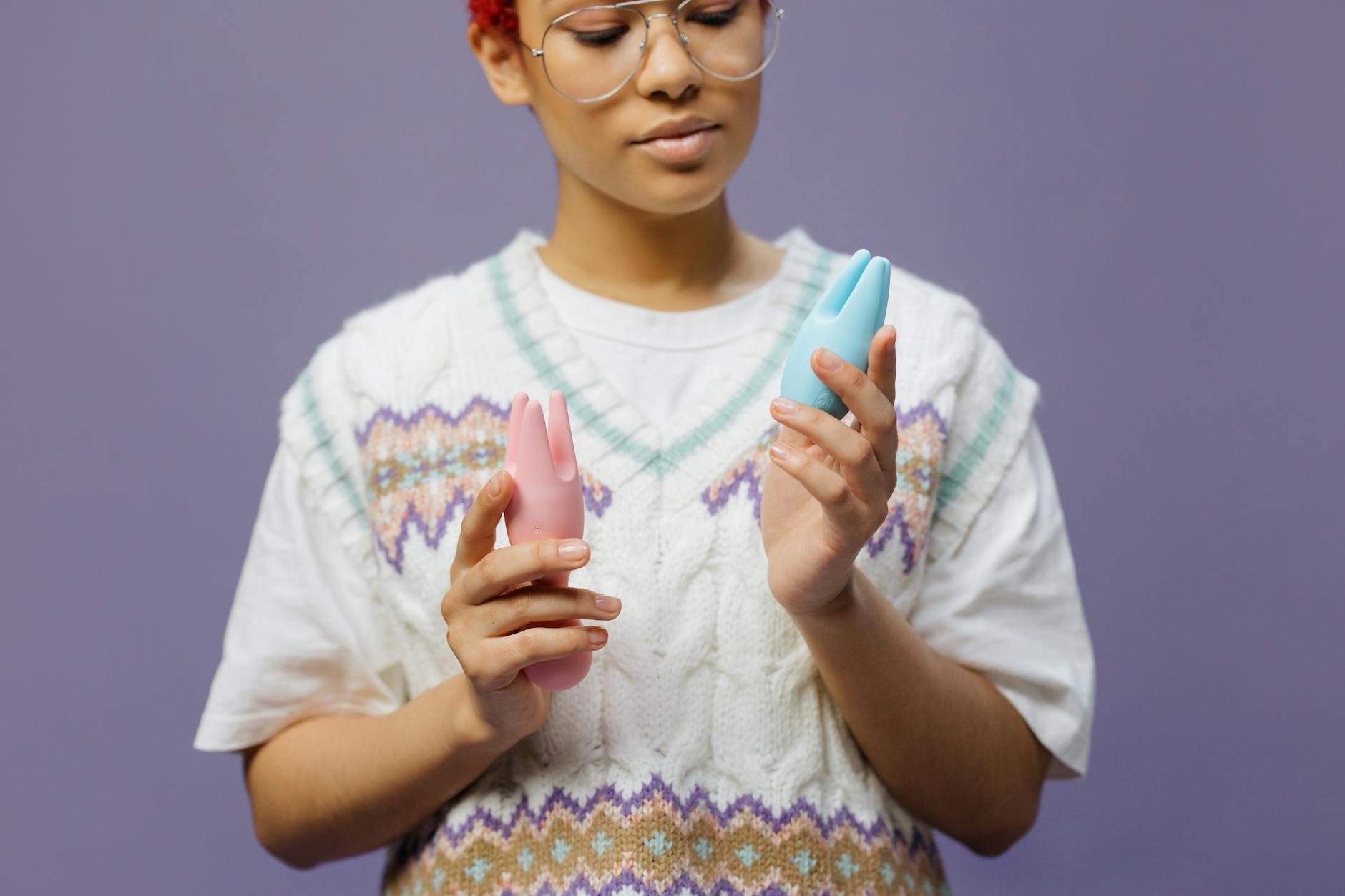
Here's the thing about wand vibrators
They vibrate. That's it. The motor shakes the entire head side to side, and you press it directly against your clitoris. The sensation is friction and oscillation combined. For some people, this works brilliantly. For others, it's like someone's scratching the same spot on your arm over and over. Intense, sometimes uncomfortable, and rarely what your body actually needs.
The problem gets worse if you have a sensitive vulva, reduced clitoral sensitivity, or if you've spent years on antidepressants that dull sensation. Traditional wand vibrators then become a guessing game: press harder (ouch), go faster (overstimulating), or give up.
Lemon clitoral vibrators work on completely different physics. And understanding why changes everything.
How air-suction lemon vibrators actually stimulate
A lemon sucker doesn't vibrate against your clit the way a wand does. Instead, it uses gentle suction combined with rapid pulsing to draw the clitoral tissue into a small chamber. The sensation is rhythmic and indirect. You're not getting hammered by a buzzing head. You're getting waves of gentle pressure that stimulate the entire clitoral complex, including the internal branches that extend into your body.
Think of it this way: a wand is like tapping on a drum. A lemon vibrator is like the drum being played from inside. The stimulation reaches more nerve endings because it's not just surface friction.
This matters neurologically. Your clitoris has roughly 8,000 nerve endings concentrated in the glans (the visible tip). But that's only a fraction of the total structure. The clitoral body, the crura (the internal arms), and the vestibular bulbs all have nerve endings too. Wand vibrators mostly stimulate the glans through direct pressure. Air-suction technology engages the entire architecture.
Why sensitive vulvas respond differently to suction
If your clitoris feels raw, painful, or overstimulated by friction, it's usually because you're experiencing one of three things: nerve endings that are literally more sensitive (sometimes genetic, sometimes from hormonal changes), tissue that's thinner or more fragile (common after menopause, childbirth, or certain medications), or desensitization from years of the same stimulation method.
With a sensitive vulva, direct friction often creates pain instead of pleasure. Your nervous system is essentially saying "too much, too fast, too direct." A lemon clitoral vibrator distributes pressure differently. The suction is gentle and enveloping rather than concentrated and jabbing. Most people with sensitivity report that lemon vibrators feel soothing where wands feel aggressive.
There's also a practical advantage: you can control the intensity by adjusting how much of your clitoral glans enters the chamber. With a wand, you're either pressing the whole head against you or not using it. With a lemon sucker, you have a gradient of sensation from gentle to intense, all within the same device.
The neurology of pulsing versus constant vibration
Your nervous system habituates to constant stimulation. If something vibrates at the same frequency against the same spot for long enough, your nerves stop registering it as novel. The sensation dulls. This is why people using traditional vibrators often report needing "more" over time. The motor keeps running at 3,000 RPM, but your sensory receptors have basically said "we've seen this movie."
Pulsing patterns work differently. A lemon vibrator creates rhythmic waves rather than steady-state vibration. Your nervous system continues to register each pulse as a new event. You don't habituate as quickly. This is why many people find that lemon vibrators deliver more sustained pleasure across longer sessions, even at lower intensity settings.
The pattern also engages your brain differently. Rhythm and anticipation activate different neural pathways than constant sensation. You're not just experiencing physical stimulation. You're experiencing a pattern your brain is actively tracking. That's part of why many people report stronger or more satisfying orgasms with lemon vibrators compared to wands.
What happens if you've been using wands for years
If you've been relying on traditional wand vibrators for a decade, switching to a lemon clitoral vibrator can feel... underwhelming at first. Your nervous system has adapted to high-intensity, constant-frequency stimulation. A lemon vibrator might feel too gentle, too pulsy, too indirect.
This is temporary. It usually takes three to five sessions of consistent use before your sensitivity recalibrates. Once it does, many people report that going back to a wand feels jarring and overstimulating. Your sensory baseline has shifted.
If you want to make the transition smoother, start with a lemon vibrator at the highest intensity setting for the first few sessions. Use it for 15-20 minutes. Pair it with lubrication (even if you don't think you need it—the glide helps) and explore different angles. Your clitoris is not a fixed target. The glans has a dorsal surface, ventral surface, left and right sides. A lemon sucker can engage each differently depending on where you position it.
When wands still win (and it's okay)
Honestly? Some people genuinely prefer wands. If you have a clit that responds to direct pressure, if you love that constant buzzing sensation, or if you're someone who orgasms easily and quickly with traditional vibrators, there's zero reason to switch. The goal is pleasure, not orthodoxy.
But if you've been struggling with sensitivity, numbness, overstimulation, or declining sensation over time, a lemon vibrator is worth trying. The difference in how your body responds can be startling. Many people report that after switching to air-suction technology, they rediscover sensation they thought was gone forever.
Practical tips for getting the most from a lemon vibrator
Start with a silicone-based lubricant applied around (not inside) the chamber. This helps create a better seal and reduces friction. Use the lowest intensity setting for your first session and work up from there. You're not trying to prove anything. You're learning how your body responds to a different stimulus.
Position matters. The opening should be centered over your clitoral glans, not off to one side. Your clitoris might be slightly asymmetrical, so explore gently to find the angle that creates the most pleasure.
Duration also matters. A lemon clitoral vibrator often works best in 10-15 minute sessions. You're not building toward overstimulation the way you might with a wand. The sensation tends to deepen and evolve over time rather than peaking quickly and plateauing.
If you've been using one particular lemon vibrator consistently for months, try switching patterns or speeds even if you've found a favorite. Novelty helps prevent habituation. Your nervous system stays engaged.
The bottom line
A lemon vibrator isn't "better" than a wand in some absolute sense. But for certain bodies, certain sensitivities, and certain types of stimulation, air-suction technology delivers something wands simply can't: distributed, rhythmic pressure that engages more of your clitoral anatomy while avoiding the trap of constant-frequency habituation. If you've struggled with traditional vibrators, that difference might be everything.
People also ask
Can you use a lemon vibrator if you've never used any vibrator before?
Absolutely. If anything, starting with a lemon clitoral vibrator is often better than starting with a wand. Your nervous system hasn't adapted to high-intensity, constant vibration, so you're more likely to enjoy the gentler, pulsing sensation right away. Start at the lowest setting, use plenty of lubricant, and don't rush. You're learning what your body likes, not proving anything.
Do lemon vibrators work if you have numbness from antidepressants?
Many people find them more effective than wands for medication-related numbness. Because the suction engages more of the clitoral structure rather than just the surface, some people report rediscovering sensation they thought was gone. That said, if you've lost sensation entirely, you might need to pair a lemon vibrator with other strategies: longer warm-up time, a partner's touch, mental engagement, or talking to your doctor about adjusting your medication timing. A toy alone won't fix medication-induced numbness, but it often helps.
How is a lemon sucker different from other air-suction toys?
All air-suction vibrators work on the same principle. The main differences are size, intensity range, pattern options, and battery life. Hellanancylemon's Lem, for example, offers multiple pulsing patterns and a gentle-to-intense intensity scale. Some air-suction toys are more intense and better for people who want strong stimulation. Others are smaller and more discreet. The underlying technology is the same. Find one that fits your preference for intensity and size.
Is there a learning curve to using a lemon vibrator?
Not really, but there is an adjustment period. The sensation feels different from a wand, so your first few sessions might not feel "right" until your nervous system recalibrates. Stick with it for at least three to five uses before deciding it's not for you. Most people who initially find a lemon clitoral vibrator underwhelming end up preferring it once they've adapted.
Can you use a lemon vibrator during partnered sex?
Yes, though positioning takes communication and practice. Some couples find it works best during foreplay or as part of mutual masturbation rather than during penetration. The size and shape mean you'll need to coordinate angles if you're with a partner. But many couples report that a lemon sucker actually improves partnered sex because it removes pressure from the partner to provide clitoral stimulation manually, which can get tiring or inconsistent. Everyone gets to focus on their own pleasure.
What if you have vulvar pain conditions and want to try a lemon vibrator?
If you have a diagnosis like lichen sclerosus, vulvodynia, or vaginismus, talk to your gynecologist first. Some pain conditions mean vibration (of any kind) needs to be approached carefully. That said, many people with vulvar pain find that the gentle, indirect stimulation of air-suction technology is more tolerable than wand vibrators. If you get the green light from your doctor, start with the lowest intensity, use lots of lubricant, and stop immediately if anything feels wrong. Your nervous system will tell you.
Explore further
If you're considering making the switch from wand vibrators to air-suction technology, you might find it helpful to understand what happens in your nervous system during pleasure. Our guide on <a href="/blog/how-to-use-lemon-vibrator-for-better-sensation-when-you-have-reduced-clitoral-sensitivity">using a lemon vibrator when you have reduced clitoral sensitivity</a> dives deeper into the neurology of sensation recovery. And if you're navigating this shift with a partner, <a href="/blog/how-to-use-lemon-vibrator-with-partner-after-being-single-for-years">our piece on using a lemon vibrator with your partner</a> covers communication and positioning strategies that couples find useful.
The right tool changes everything. Your pleasure matters, and so does finding the method that actually works for your specific body.